
The ISPConfig web control panel included with our VPS servers is Open Source and allows you to manage your servers directly from your browser. Here is a short introduction video:
The interface is stable, secure, and ultra-fast. Manage your websites, monitor resource usage, email accounts, customer accounts, software, FTP users, MySQL databases, cron jobs, shell users, DNS, IPv4 and IPv6 — all in one place.

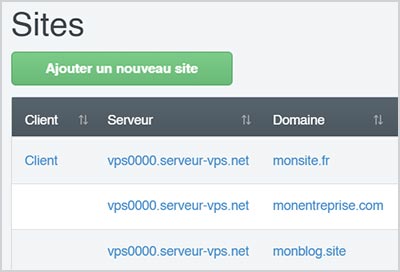
Websites
Servers with ISPConfig 3 are ideal for hosting multiple websites or a single site requiring significant resources (CPU, RAM, etc.).
Easily add a new site to your server and assign disk space, bandwidth, and other quotas.

Domains
Manage your domains and create subdomains, aliases, and redirects. An SSL certificate is included to enable HTTPS on all your domains/websites.
Configure your DNS zones and servers. You also benefit from a secondary DNS server for your domains.

Email Accounts
Manage email addresses based on the domains linked to your plan. Add mailboxes, aliases, email forwarding, mailing lists, anti-spam filters, whitelists, blacklists, and more.
Access your Webmail and mail server. Retrieve emails from external POP3/IMAP servers, and view statistics, quotas, and mail server settings.

Databases
You can create new MySQL databases or manage existing ones.
Easily create database users from the same interface.
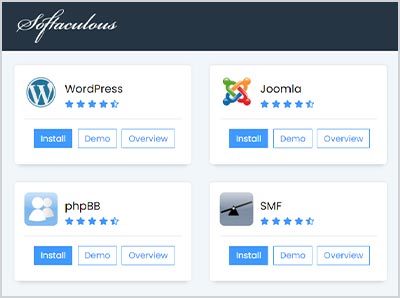
Softaculous Application Installer
LWS has added the option to install Softaculous for free in your ISPConfig control panel with a single click.
You have access to a limited version of Softaculous (in the Tools section of ISPConfig). To benefit from the full version, a license is required (≈ €1 on softaculous.com).
Softaculous is an application auto-installer that lets you install WordPress, PrestaShop, Joomla, Drupal, and more.
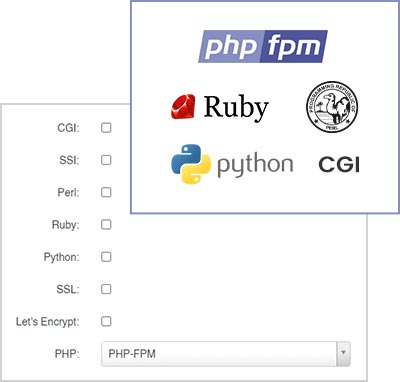
PHP-FPM, OPcache, Ruby, and more
PHP-FPM is a popular alternative PHP implementation used to boost website performance.
OPcache is a built-in PHP caching engine that improves performance for PHP-based websites.
Ruby is mainly used to build web applications.
Perl is used for system administration, networking, and various user interface applications.
CGI provides an interface between the HTTP server and programs generating web content.

Reseller Mode
ISPConfig allows the administration of servers, webspaces, resellers, virtual hosts (websites), and clients.
ISPConfig includes 3 levels: server administrator, resellers, and webmasters. Webmasters can only manage websites, domains, and email accounts.
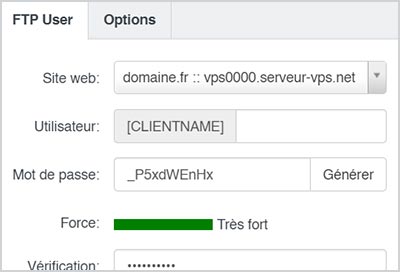
Website Access
Access your site using FTP or WebDAV credentials. If you have a CMS installed on your hosting, simply log in via its admin URL using your credentials.
You can also create protected folders and users for restricted directories.
Command Line
ISPConfig can, for instance, be manually started/stopped via the command line.
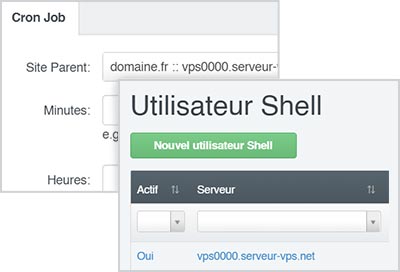
Create new Shell users or cron jobs directly from the ISPConfig interface.
Statistics
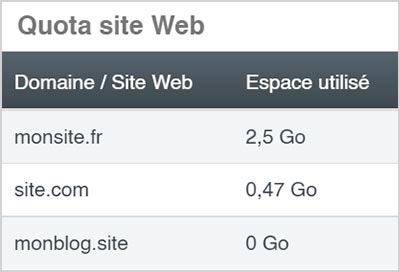
View and analyze your web traffic, FTP traffic, website quotas (SSD storage), database quotas, and backup statistics.
Monitor your server status, RAID, server load, resource usage, memory, service status, log files, and more.
System
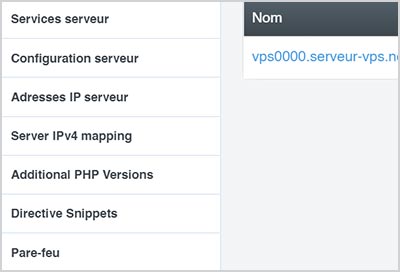
In the System settings of ISPConfig, access server IP addresses, IPv4 mapping, additional PHP versions, Directive Snippets, firewall, system configuration, language editor, and remote actions (OS and ISPConfig updates).

Apache or Nginx
Choose Apache or Nginx when ordering or by reinstalling your OS from your LWS Panel. These web servers allow users to deploy their websites on the Internet.
Apache powers over 67% of servers worldwide. What’s the difference with NGINX? Apache uses a process-driven approach and creates a new thread for each request. NGINX uses an event-driven architecture to handle multiple requests within the same thread.

Varnish Web Cache
Varnish Cache is an HTTP accelerator and reverse proxy launched in 2006. This web cache optimizes performance and therefore speeds up websites.
It also reduces the load on the web application server’s CPU and provides extra protection against DDoS attacks.

Redis, Memcached
Redis stores in-memory data structures to simplify complex code and reduce the number of lines needed.
Memcached is a distributed in-memory caching system designed to be simple and efficient.
Memcached serves as the primary cache, while Redis is used for its logical data-structure-based caching.